
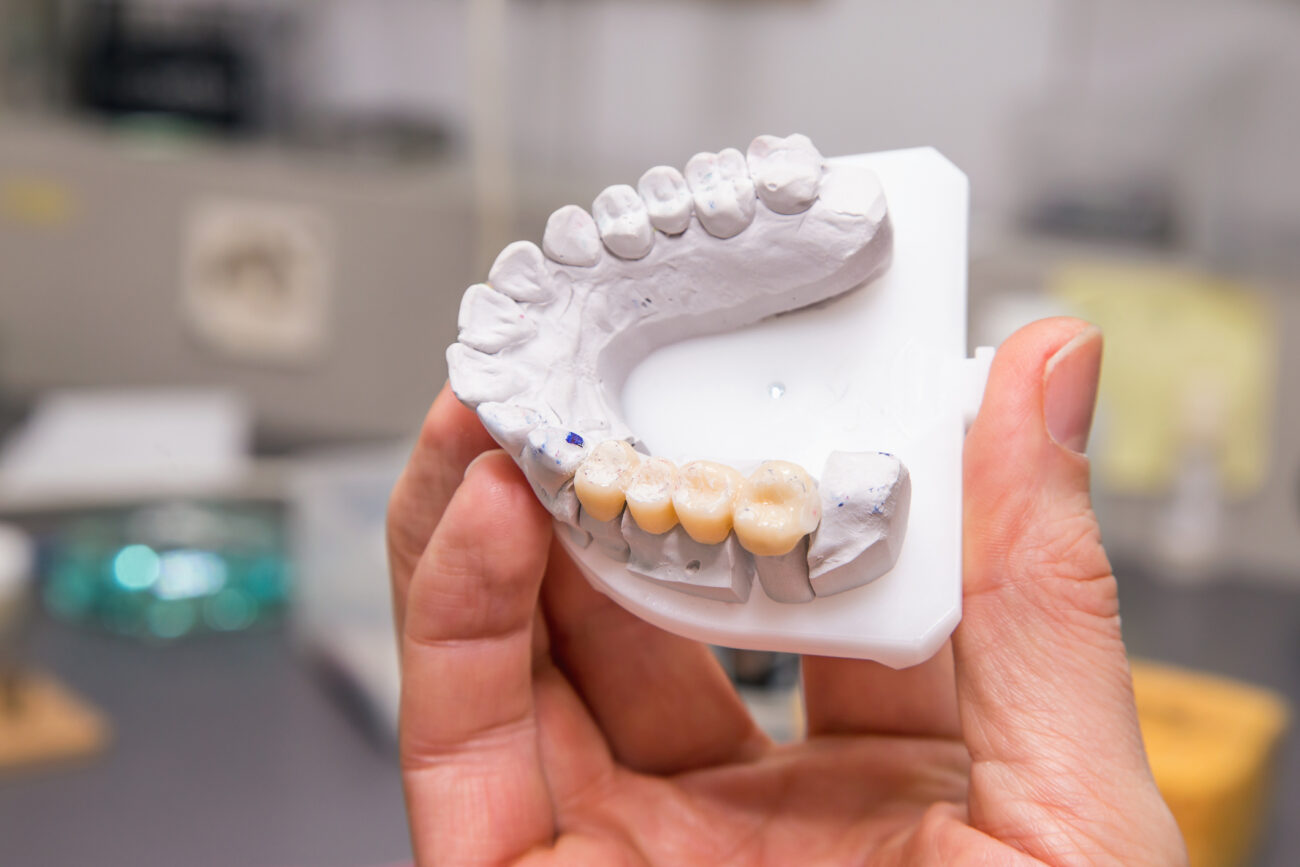
Choosing between a dental bridge and a dental implant depends mostly on your jawbone, the teeth beside the gap, and your timeline. A bridge spans the space using the neighboring teeth for support. An implant replaces the tooth root itself with a post set into the jawbone. Both are fixed, non-removable options.
Dental Bridges and Dental Implants: What Each Solution Actually Is
A dental bridge is a fixed restoration that fills a gap by cementing crowns onto the two teeth beside it and suspending a false tooth between them. A dental implant is a titanium or zirconia post placed in the jawbone to replace the missing root, then topped with a custom crown. Both are fixed, and neither comes out.
A bridge and an implant solve the same problem in two very different ways. Understanding the hardware makes the decision easier.
What Is a Dental Bridge?
A traditional bridge is one connected piece with three parts. Two crowns sit on the teeth flanking your gap (the abutment teeth), and a suspended false tooth (the pontic) fills the space between them. The whole unit is cemented into place, so it doesn’t come out.
Bridges can carry more than one pontic when several teeth in a row are missing.
What Is a Dental Implant?
An implant has three separate components. A titanium or zirconia post takes the place of the missing root, an abutment connects the post to the restoration, and a custom crown finishes the tooth above the gumline.
Nothing touches the teeth on either side. That’s the defining difference.
Why Does Replacing a Missing Tooth Matter?
Your jawbone needs pressure from chewing to stay dense. When a root disappears, the bone underneath it stops getting that signal and gradually shrinks.
Other changes follow:
- Neighboring teeth tip and drift into the open space
- The opposing tooth drifts down or up, hunting for contact
- Your bite shifts, which strains the remaining teeth and the jaw joints
- Chewing load concentrates on fewer teeth
Dr. Rachel Barone evaluates all of this before recommending anything. Both bridges and implants are fixed restorations, which means neither one comes out at night the way a partial denture does.
How Each Treatment Works, Step by Step
A bridge typically takes two to three weeks and two visits. An implant takes several months, because the post must fuse to the jawbone before the final crown goes on. Both treatments start the same way: imaging, a bite evaluation, and a conversation about what you want long term. Implant-trained Dr. Barone walks you through both sequences before anything begins, so you know what each visit involves and how far apart those visits fall.
How Does the Bridge Process Work?
- Exam and imaging. We check the health of the abutment teeth and confirm they can carry the load.
- Shaping the abutment teeth. Enamel is reduced on both neighbors so crowns can seat over them.
- Impressions or a digital scan. Your bridge is designed from this record.
- Temporary bridge. You leave with the gap covered and function restored.
- Final cementation. We verify fit, contacts, and bite, then bond it in place.
How Does the Implant Process Work?
- Evaluation and 3D imaging. A cone-beam scan shows bone height, width, and the position of nerves and sinuses.
- Preparatory steps, if needed. Extraction of a failing tooth, a bone graft to rebuild volume, or a sinus lift in the upper back jaw.
- Placement. The post is set into the bone and the site is allowed to heal.
- Osseointegration. Over roughly three to six months, bone cells grow directly onto the surface of the post and lock it in. That biological fusion is what makes an implant behave like a root.
- Abutment and final crown. Once the post is stable, we scan and deliver the crown.
How Comfortable Is Treatment?
Feeling nervous about surgery is common. You’re far from alone. Relaxation dentistry is available for patients who’d rather doze through the visit, and local anesthetic keeps the site numb throughout. Most patients describe implant placement as easier than they expected, with soreness that responds well to over-the-counter medication.
Benefits of Each Option, and What You Give Up
Neither choice is universally better. Each one trades something away.
What Does a Bridge Give You?
- A finished result in about two to three weeks
- No surgery and no healing period
- A workable option when bone volume is limited
- A good fit when the neighboring teeth already need crowns
What Does an Implant Give You?
- Bone stimulation that helps preserve ridge height and facial support
- The teeth on either side stay completely untouched
- Daily care matches a natural tooth: brush, floss, done
- The longest expected service life of any single-tooth replacement
- Independent failure risk, meaning one tooth’s problem stays one tooth’s problem
Both options restore chewing power, clear up speech that gaps tend to blur, and look natural when the shade and shape are matched well. Both also stop neighboring teeth from drifting.
Dental Bridge vs. Dental Implant: Side-by-Side Comparison
| Factor | Dental Bridge | Dental Implant |
|---|---|---|
| Treatment time | About 2–3 weeks | About 3–6 months, longer with grafting |
| Surgery required | No | Yes |
| Effect on adjacent teeth | Two healthy teeth are reshaped | Neighbors untouched |
| Bone preservation | None under the pontic | Stimulates and helps preserve bone |
| Typical lifespan | Often 10–15 years | Often 20+ years; crown may be replaced sooner |
| Daily cleaning | Floss threader or superfloss under the pontic | Standard brushing and flossing |
| Common failure mode | Decay at the crown margins on abutment teeth | Peri-implantitis, gum and bone inflammation from plaque |
What If You’re Missing Multiple Teeth in a Row?
The math changes when you’re missing two, three, or four teeth side by side. A traditional bridge grows longer and puts more use on the same two anchor teeth, which raises the risk of one giving out.
An implant-supported bridge solves that problem. Two implants can carry three or four teeth, so you get bone stimulation and a fixed result without placing an implant for every single tooth.
Which Differences Matter Most Day to Day?
Once either restoration is finished, the differences you’ll actually notice are fairly small. A bridge asks for a floss threader or superfloss under the pontic every day, since ordinary floss can’t slip between connected crowns. An implant crown gets cleaned the way a natural tooth does.
Both need routine checkups so we can watch the margins, the gum tissue, and the bite over time. Grinding forces matter for either restoration, which is why a nightguard often comes up in the same conversation.
Who Is a Good Candidate for Each Treatment
Most people qualify for one option, many qualify for both, and a few need groundwork first.
When Might a Bridge Suit You Better?
- Bone volume is insufficient and you’d rather not have a graft
- A medical condition or medication makes elective surgery unwise
- You need the gap closed quickly, ahead of a wedding, a move, or a work commitment
- The neighboring teeth already have crowns or large fillings
When Might an Implant Suit You Better?
- The teeth on both sides of the gap are healthy and untouched
- Bone height and width are adequate on your 3D scan
- You don’t smoke, or you’re willing to pause during healing
- Your gums are free of active periodontal disease
What Issues Do We Address First?
Untreated gum disease, uncontrolled diabetes, active decay, and heavy grinding all raise the risk of failure for either restoration. None of them is automatically disqualifying.
Periodontal therapy can bring inflamed tissue back to health. A nightguard protects both bridges and implant crowns from clenching forces. Getting blood sugar into a stable range improves healing. Plenty of patients who hear “not yet” become excellent candidates within a few months.
Younger patients are a separate consideration. Because implants don’t move with a growing jaw, Dr. Barone typically recommends waiting until facial growth is complete before placing one.
What Does Your Consult Include?
At Gunbarrel Dental Center, a missing-tooth consult includes a 3D scan, a bone assessment at the site, a bite analysis, and a clear presentation of both options with their trade-offs. Dr. Barone completed an Advanced Education in General Dentistry residency and holds Fellowships in the International Congress of Oral Implantologists and the American College of Dentists. That implant training shapes how she reads your scan and how carefully she explains what each path would ask of you.
You’ll leave understanding why one option fits your mouth better than the other. That’s what person-centered dentistry looks like in practice.
Frequently Asked Questions About Bridges and Implants
Which lasts longer, a bridge or an implant?
Implants generally last longer. A well-maintained implant post frequently serves 20 years or more, while bridges commonly need replacement somewhere around the 10 to 15 year mark. The implant crown may be replaced before the post ever needs attention. Daily hygiene and regular checkups influence both numbers more than any other factor.
Does getting a dental implant hurt?
Placement is done with local anesthetic, so you shouldn’t feel the procedure itself. Afterward, most patients report mild soreness and swelling for a few days, similar to having a tooth removed. Over-the-counter medication usually handles it. Relaxation dentistry is available if anxiety, not pain, is your main concern.
Can a bridge be replaced with an implant later?
Often, yes. When a bridge reaches the end of its life, we can evaluate whether the ridge still has enough bone for an implant. Keep in mind that bone under the pontic has been shrinking the entire time the bridge was in place, so a graft may be needed. Switching is easier to plan for than to improvise.
How long can I wait after losing a tooth before deciding?
Bone loss begins soon after a tooth is removed and is most rapid during the first year. Neighboring teeth also start to drift within months. Waiting doesn’t rule out treatment, but it can add steps like grafting or clear aligner work to reopen the space. Sooner is simpler.
Do implants or bridges look more natural?
Both can look convincing. Implants hold a slight edge in the front of the mouth because the crown emerges from the gum the way a natural tooth does, with no bulk over the ridge. Bridge esthetics depend heavily on gum contour under the pontic. Shade matching and lab skill matter a great deal either way.
Is a bridge ever the better choice than an implant?
Absolutely. When the adjacent teeth already need crowns, a bridge accomplishes two goals with one restoration. It’s also the practical choice when bone is thin and you’d rather avoid grafting, when a health condition makes surgery risky, or when your timeline is short. The better option is the one that fits your mouth and your life.
Losing a tooth is frustrating. Choosing what comes next shouldn’t be. Dr. Rachel Barone and our team at Gunbarrel Dental Center have served this community for years, and a missing tooth is one of the most common reasons patients come to see us for the first time.
We’ll show you the scan, explain what we see, and give you a written estimate for each path, so you can focus on what matters most to you. There’s no pressure attached, just a respectful partnership and a clear recommendation you’re welcome to think over at home before deciding anything.
If you’d like to compare a bridge and an implant for your own situation, you can schedule consult whenever the timing works for you.